By Osman A. Khairi and Kamran KhanCuriously, Pakistan passes through a cycle of political tumult and unrest after about every ten years that somehow leads to a change of the ‘faces’. After the political upheavals of 1958, 1968, 1977-78, 1988, and 1998-99 we are about to enter into 2008 with yet another ‘middle class revolution’ brewing in some urban areas.
Politics is much like Plato’s allegory of a cave where we do not see the real world but only the images of the people outside the cave being formed on the wall. Likewise, on the Pakistan political stage, we do not see the ‘reality’ but only the ‘images’ that are being projected onto the screen, now immensely powerful images with global satellite TV.
Sentimental viewers of mostly middle classes tend to get so much emotionally involved in the play that they start ascribing their own latent ‘dreams’ and memories of their own unfulfilled youthful desires to the different ‘players’ on the screen.
All politics is essentially the interplay of some conflicting powers competing for expanding or protecting their interests. Modern politics is also the art of camouflaging this conflict in some more ‘popular’ garbs. We are at times at a loss to discern the real conflict beneath the multiple layers of covering.
Let’s attempt to see what is happening around us and who the real ‘players’ are?
Today, in our political life we are witnessing mainly five contradictions/paradoxes interacting with each other on different planes:
(i) The underlying conflict between the US-led western powers’ hegemonic interests in the south and central Asian region and a powerful and politically dominant Pakistan military that is now armed with nuclear weapons. Currently, this conflict has become the main driver of most political happenings in the country and is directly impacting all other conflicts in our society.
(ii) The conflict between the directly ruling military and the political power blocks of ruling elite who aspire to extract their pound of flesh in the plunder of national wealth. This conflict has been generally the most dominant factor in our national politics till 1988.
(iii) The internal conflict among political parties representing coalitions of different power blocks competing with each other for a power and wealth sharing role with the military and in the process seeking blessings and patronage of the western imperial powers.
(iv) The aspirations of the expanding middle classes for a greater role for themselves in the governance and the system of patronage currently dominated by only a small ruling elite. These aspirations are usually expressed in Op-Ed pages and Letters to Editors in English Newspapers and on electronic media in terms of demands for more social and political ‘freedoms’ in line with western democratic political models, The middle class aspirations of at least the urban areas of Sindh have found an independent political representation in the form of MQM. A rising middle class of Punjab has yet to find an independent political representation.
(v) The burgeoning desires and demands of common men and women and the toiling masses of the country for emancipation from oppressive poverty and an unfulfilled dream for better living that can meet their basic needs of shelter, health and education have not yet found any voice and political representation.
In the world arena, G8 powers and China are simultaneously competing and collaborating with each other for expanding their economies. The US has taken an outright aggressive posture to dominate the world economy with brute force and is prepared to unleash new wars to demonstrate its capability to do so for gaining exclusive control of the world’s energy resources to ensure its continued hegemony. The world’s largest oil and gas reserves, so critically vital for the industrially developed economies having the ambition of playing the role of global powers, are located in and around the regions of the Middle East and the Central Asia. Most of the oil supplies pass through the Persian Gulf. Pakistan with its large standing army and nuclear weapons is located too dangerously close to these prized regions. China critically needs an outlet in this area through Pakistan to resist any blockade of its vital energy supplies. This global conflict has now become a predominant factor in the politics of many weaker economies like Pakistan which happen to be located in the vortex of this global energy game. Earlier, before the development of colonial and post-colonial world, international conflicts seldom played this high level of disturbing influence on the local politics and domestic power conflicts usually played dominant roles in the societies. Now for a long time the local interest groups of the ruling classes do not have sufficient political and military strength to challenge the global players and have no choice but to compete among themselves for seeking a role to serve one or the other dominant player in the bigger global power game and during the currency of this ‘appointment’ skim off some national wealth for themselves in awarding state controlled contracts and in the deals for procurement of weapons from their masters.
In 1947 Pakistan was founded in areas with predominantly agrarian and tribal socio-political structures and matured political institutions were conspicuous by their absence. The only state institution in this part that was fairly matured and developed was the military that was mostly recruited by the British colonial administration from the Punjab and parts of NWFP. The Pakistan army having strong and disciplined institutional support system soon gained preeminence in the newly formed state structures in early 1950’s and finally established its direct rule in 1958, ruthlessly suppressing the nascent political evolutionary process. The landed aristocracy and the merchant bourgeoisie soon assumed the role of junior collaborators and quickly learnt the politics of gaining economic benefits through patronage of military generals. Building its own independent extensive revenue-generating economic base, Pakistan military became the sole negotiator for the country in the international power game during the cold war. The rising imperial power in the Asian theater, the US swiftly developed direct links with a strong standing army in south Asia to counter balance the Soviet Union and China’s growing influence in the region and the Middle East.
Exploiting the opportunity provided by China’s breaking away from the Soviet Union’s camp in early 1960’s, the Pakistan army clearly tilted towards China to seek protection from a possible pincer attack of soviet dominated powers; from India on its eastern border and from Afghanistan on the west. The China card also provided a timely lever to the Pakistan army for bolstering its position in its negotiations for more military aid from the US and European powers. Extra-ordinarily warm Pak-China Friendship in 1960s and 1970s was the need of Pakistan army to mitigate the fear of betrayal from the US and the West in Pakistan army’s attempt to resist Indian hegemony in south Asia.
During the process of the economic growth in the last about 50 years the middle classes have steadily expanded in numbers, increasing disposable incomes and social influence while accumulation of wealth in large urban areas has dramatically increased in the last about 10 years. Sharing of some benefits of the economic growth during military’s first direct rule in Ayub’s era produced first signs of middle class gaining strength and consequently asking for more political freedoms and greater role in governance. Primarily the youth of those middle classes who actually benefited from the magic of state sponsored capitalism came out on the streets demanding freedoms in 1968, a beginning of the first radical students’ movement in the country. Triggered by the students’ agitation, the first (and, perhaps, the last) mass political upheaval was witnessed in Pakistan when Zulfiqar Ali Bhutto cleverly exploited political discontentment of the middle classes and successfully agitated the urban poor by inviting them for ‘gherao aur jalao’ raising a radical slogan of the promise of "
roti, kapra, aur makan" (bread, clothing and rooftop)!
Contrary to general belief, barring a few marginal concessions, this haphazard demonstration of the street power and ‘labour agitation’ did not yield any fruits in the form of meaningful ‘political freedoms’. In fact, as usual, it resulted in a ‘counter-revolution’ from the army, which again assumed the role of ‘direct ruler’ with Yahya Khan imposing another martial law. It was the subsequent humiliating defeat of Pakistan army in the East Pakistan and the eastern part winning its independence in December 1971 that, in fact, forced the Pakistan Army to concede to the civilian rule by handing over the political power to populist Zulfiqar Ali Bhutto.
Unfortunately, Zulfiqar Ali Bhutto squandered this first and probably the last opportunity to permanently lay the foundation of a civilian political rule in Pakistan and soon succumbed to his own complexes and in pursuit of his personal whims and political vendetta he unwittingly helped resurrect the arbitrary powers of the military. Army soon recouped its strength and struck back in vengeance in 1977. Bhutto, a populist elected Prime Minister from the political elite of the country, was hanged essentially for the unpardonable crime of personally humiliating the Pakistan army.
Soon a major event occurred on the western borders of Pakistan. Soviet army walked into Afghanistan in 1979 to bolster the tottering pro-soviet regime. Pakistan army became the darling of the west and billions of US dollars were pumped by the West and the Saudi Arabia through Pakistan army to whip up an Islamic Jihad against godless communists – a US backed proxy war against Soviet Union. Intoxicated with dreams of establishing a pure Islamic Caliphate, Islamic Jihad volunteers were recruited by CIA from all over Muslim world and trained and equipped to fight a guerrilla war in Afghanistan. Pakistan army gained immense regional influence while few individual generals amassed huge wealth by skimming off the weapons supply line. To consolidate its tight control over domestic politics, with a green light from Washington, Pakistan army succeeded in creating ‘constitutional safeguards’ of assuming an arbitrator’s role by obtaining the indirect power through the office of the President to dissolve the elected parliament whenever it feels the ‘integrity’ of Pakistan is threatened. The political structure of the country was thus permanently skewed. The political landscape of south and central Asia significantly changed after the withdrawal of Soviet Union from Afghanistan and signing of the Geneva Accord. After successfully inflicting fatal wounds to the Soviet Union in Afghanistan, the USA wished to ‘pack up’ and leave like shooting of a Hollywood movie coming to an end. But in the words of Zbigniew Brezinski ‘some stirred up’ Islamic Jihadis and Pakistan army were not too pleased with the idea. Soon Pakistan army chief and President General Zia ul Haq and a galaxy of key military generals together with the US ambassador were blown up in a mysterious military plane crash near Bahawalpur in 1988.
The army temporarily suffered a shock and stepped back. The power was transferred to a pliant civilian set up under Benazir Bhutto, the daughter of hanged Prime Minister Zulfiqar Ali Bhutto. Thereafter, it is a long and sad story of corrupt and inept politicians coming and going, in a merry-go-round one after the other, at the pleasure of real power brokers as part of the ‘permanent establishment’, and in the process amassing enormous wealth for themselves and their cronies in a state sponsored plunder of national wealth.
After the collapse of the Soviet empire, the global political landscape has changed significantly. The US backed Iraq-Iran war had come to an end in 1988 without a conclusion. The US lured its protégé Saddam Hussein walking into Kuwait and then immediately unleashed a ‘Desert Storm’ in the Middle East and successfully destroyed the Iraqi Army, a war machine becoming quite strong and well equipped during the previous war. Pakistan army is another politically well entrenched, well-oiled and fully equipped war behemoth in this sensitive region that needed to be cut down to the size. Pressure on GHQ was gradually mounted while at the same time collaborating on many vital matters of mutual interest. Meanwhile, Pakistan army succeeded in gaining some strategic depth by carving out an area of influence in Afghanistan with the help of Taliban that it created in its religious-military training schools in Pakistan. After initial enthusiasm of the US for a stable regime not hostile to their designs for access to oil in the region (who cares if it was openly trampling democratic and women’s rights in the name of mediaeval Islamic Caliphate), the obstinate Taliban in collusion with Pakistan army were turning out to be a hard nut to crack. For the US strategic planners, the genie of Islamic Jihadis that they had gleefully created was not prepared to roll back into the bottle. On top of it, Pakistan defiantly exploded its nuclear devices in 1998 in response to India’s nuclear detonations. A dangerous missile race for acquiring long range nuclear devices delivery capability ensued in the region making it even more volatile and explosive. Eventually, the birds came back to roost. On the morning of infamous 9/11 the Taliban-protected Al-Qaeda struck like lightening at the US symbols of hegemony by destroying World Trade Centre in New York and damaging the Pentagon in Washington. The world was not to remain the same.
A ‘War of Terror’ in retaliation was unleashed with full US imperial military might in Afghanistan, leaving little choice for other allies including next door Pakistan but to acquiesce or being ‘thrown back into the stone age’. Pakistan hurriedly complied. Next target of full frontal attack was beleaguered Iraq, which is now practically dismembered and only rubble has remained there to bounce, reminding the destruction of Baghdad by the Mongol hordes of Helegu Khan in 1258. Saddam Hussein is executed to make a horrible example for others and a strategic control over enormous oil wealth in the region is successfully demonstrated to terrorize the whole world. Sabers are now rattling for the next target in Iran and again Pakistan army’s role in future in the new war game would be critical.
For some time now US think tanks like Carnegie Endowment Institute of International Relations have been building up a case that Pakistan army has long been using the bogey of Islamic Fundamentalists under its own patronage to scare the Western world and every time succeeds in negotiating a ‘deal’ for itself when pressures are mounted. Suggestions are being made to finally call the bluff and sort out this matter once and for all. It is, however, ironic that both the adversaries successfully use these Islamic Fundos (some of them are truly misguided and some are downright corrupt) towards scoring points over each other. Now the full steam is on. Diplomatic pressure was put on Pakistan military to come to terms with chosen ‘political leadership’ of Benazir Bhutto, who is obviously too eager to play the game at whatever terms. Amusingly reminiscing his association with Benazir Bhutto in Oxford, Council on Foreign Relations (CFR) President Richard Hass introduced her recently in August 2007 to a galaxy of real global power brokers in a gathering in Washington as the selected candidate for the new job in Pakistan. We know CFR is the most influential body of the powerful policy makers in the USA. Most of the US doctrines that have had significant impact on the course of world history were always first expressed in CFR and its organ Foreign Affairs. The recent notable example is Samuel Huntington’s The Clash of Civilizations (on the intriguing origins and history of CFR and its likes sometime later). Pak-Iran oil refinery, Iran-Pakistan-India gas pipeline, and other gas pipeline projects in the region are scuttled under pressure from the US. China came to the rescue of Gwadar Port project and is investing significant sums to gain a strategic outlet for its oil supplies and trade routes from the region. No wonder, there was a sudden upsurge in an almost dead horse of Baloch nationalist movement operating from its bases in Afghanistan and most of the project work in the province came to a stand still. Full sympathy to a genuine movement for Baloch national rights and for equitable distribution of their natural resources, but a sudden championing of this ‘national cause’ by likes of Akbar Bugti was a little more then what the eyes can see on the media. When army brutally eliminated the irritating thorn of Akbar Bugti and his militia in a ‘clinical operation’, a Pakistani Taliban commander Abdullah Mehsud who spent five years in Guantanamo Bay and was handed over to the US backed Karzai regime in Afghanistan, reappears and abducts two Chinese engineers of whom one was later killed. There is a simultaneous rise in militant Jihadi movements in the tribal areas bordering Afghanistan soon spreading into otherwise settled areas of Swat and adjoining territories. Reportedly, India has set up more Consulate offices in Afghanistan then in any other country in the world, all of them in the eastern provinces bordering Pakistan. Both Baloch liberation movement activists and Red Mosque militant Jihadis in Islamabad and other towns in the northern areas started specifically targeting Chinese nationals, leaving all American and European nationals undisturbed. It is a strange and unexplainable phenomenon in view of the long tradition of almost sentimental Pak-China friendship traditions. Dubious Islamic Jihadi groups defiantly challenged government writ in the heart of Islamabad and in Swat and strangely, otherwise quite liberal media, suddenly started unleashing a blitzkrieg in sympathy of the antics of fundamentalist militant Jihadis. Western media power and the local and foreign NGO groups and Internet groups are all in unison and an unusual display of global sympathy with the fighters of democratic rights on the streets of Pakistani towns out of the whole world is too good to believe.
In this backdrop higher judiciary also started displaying an over enthusiastic activism that was almost bordering on sheer adventurism in the given state structures, though, undoubtedly taking up very valid causes, specially those that are very close to the hearts of the middle classes and the Intelligentsia of the country. There was a marked increase in suicidal bomb attacks at different military and civilian targets inside cities and towns of Pakistan.
As expected, the besieged Pakistan army struck back in retaliation and ruthlessly crushed Islamic Jihadis in Islamabad and took draconian measures against recalcitrant judiciary and the media. Eventually, emergency is declared in the country suspending the fundamental and human rights and most of the activist judges of the superior courts have been summarily dispensed with. Some sections of the Intelligentsia, particularly the lawyers and journalists have come out on the streets to protest against government’s high-handedness and strict measures. The new and affluent middle class developing in Punjab is particularly agitated, quite vocally giving it an ethnic undertone. For the first time in history otherwise completely apolitical students of elite educational institutes like LUMS and FAST in Lahore, where mostly sons and daughters of affluent classes are enrolled, have shown some signs of political agitation on their campuses.
But no intelligent observer can escape noticing that the common men and the masses are conspicuously absent from this drama being played on the streets of Lahore and partly in Karachi ostensibly for the peoples’ ‘democratic rights’. A common man has apparently learnt its lessons in the street agitations of 1968 and in 1977, which were nothing more then stage shows organized by some powers to topple one set of rulers and bring other more pliant cliques, eagerly bidding for a new role in the changed circumstances. No wonder, all agitation is specifically for the change of faces only. Even the rhetoric is ostensibly for western democratic rights that are more suited to warm up the affluent middle classes and the influential opinion makers in Intelligentsia and no promise for the change of common men’s life is forthcoming. Street demos ‘organized’ in some large urban centres are typically characterized by pretty faces of some well-fed women wearing designer dark glasses gleefully holding placards and banners with slogans all written in English where only a minority can read or write even Urdu, let alone chaste English language! Photographs of these demos, perhaps, have better ‘news value’ for the next morning local and international newspapers. In street power shows mostly filled with hired workers dancing mechanically atop large contract vehicles and curious onlookers in the sides, the same old tried and tested faces of corrupt politicians bejeweled with diamond studded accessories and protected by bullet-proof vehicles and rings of private security guards appear masquerading as ‘champions of democracy’. It is said, history repeats itself; first time as a tragedy, second time as a farce. All political parties have conveniently forgotten to even talk about the solutions for real issues faced by toiling men and women every day in our cities, small towns and the villages. It seems having learnt their lessons of the powerful mass appeal of the slogans of 1968 agitation, army and the ruling elite have agreed not to raise that genie again in Pakistan’s politics. There is a consensus on a clear shift from the real issues.
It seems currently a war of nerves is being fought between Pakistan army and the global powers bent upon gradually putting it in a tight corner and clipping its wings. Each party is scoring winning points over the other in each successive covert battle. Though, Musharraf regime is generally accused of selling its soul to its American masters in the ‘war on terror’, the indications are that while collaborating with the US led coalition in its broad policy objectives, it seems to have taken a posture of ‘strategic defiance’ in terms of domestic political affairs and its relations with China and Iran. To put international opinion pressures, a well orchestrated media war has been unleashed in the West to embarrass Pakistan. There is an unusual display of clear and direct interference in the domestic political affairs by the US and other European diplomats. There is a flurry of publicly admonishing statements and frequent arrivals in the country of plenipotentiaries of imperial west ‘advising’ how to behave. Strangely, US Ambassador is openly visiting the houses of leading lights of the protest movement against sitting government. Apparently, it is a delightful moment for a slavish middle class Intelligentsia. It is, however, ironic that the elite civic society which accuses the government of succumbing to the pressures of the US masters after 9/11 and becoming a stooge in the hands of US and the west in their fight against terror and killing its own people, in the same breath, is taking immense pride in these acts of the viceroys of the west. Gleeful acceptance of such brazen foreign interference in the internal political affairs of the country is setting a bad precedent that will continue to haunt this nation for a long time. We have lost our national pride and don’t even notice it. Last such shameful interference was only seen in 1977 when a beleaguered Bhutto agreed to let then Saudi Ambassador act like a supreme arbiter with a whip in his hands deciding matters between the interlocutors of PPP government and the arrested PNA leaders in Sihala Rest House near Islamabad in the wake of violent anti-government agitation on the charges of Bhutto’s rigging of the elections.
In politics and international relations there are no permanent friends and no permanent enemies. Those who have today locked their horns defending own turfs on some disagreements may tomorrow become friends and collaborators and turn against those who are happily siding with either of the two. This has been amply demonstrated in the last 60 years of the history of Pakistan politics and the last more than 2,500 years of world history. No need to get emotionally trapped in a particular moment in time and space. We need to take, using a modern term, ‘Google Earth’ view of the global events of history in a larger perspective, moving in time.
What options do we have?
To be fair, I am at a loss. For the first time in my life (24 to be precise), I am clueless. On the one hand we have an army that has dominated the politics in our country for the last about 50 years and has been ruling us directly or indirectly. Taking advantage of its paramount political power, it has also greatly expanded its own business empire directly competing with civic society and continues to drain better part of our national resources on unproductive activities to the clear disadvantage of public health, education and common well being. All saner elements of our society wish to see army limiting itself to its primary job of defending the borders; political institutions to be built and democratic rights of the people to be restored; and a fair and equitable distribution of fruits of the economic growth among all classes of society to ensure shelter, gainful employment, education and health facilities for everyone. We all know that no one voluntarily relinquishes its power and privileges and bestows equal rights on others as a gift. One must fight for it.
On the other hand we have an aggressive juggernaut of US expansion in the region trampling national sovereignty of countries under its feet with impunity. It wants to maul Pakistan army not for any love of the people of Pakistan or for its compulsive desire for restoration of democracy in every country. For global powers nuclear assets in the hands of a politically dominant strong standing army with some ‘stirred up’ Islamic fundamentalists lurking around is too big a risk for their designs in the region. They have clearly reserved greater roles for India to play in the region, which seems too eager to play ball with them. They are out for grabbing resources for themselves and preventing others (China) from gaining any strategic control over them. If there are few irritants on their way like Iraq, Syria, and Afghanistan or may be Iran or Pakistan tomorrow, they wouldn’t hesitate to obliterate them, if required. They are known to support and bolster ruthless tyrants and military dictators as long as they serve their purpose and then hang them on the streets. Inviting foreign tyrants and military powers to settle scores with domestic adversaries has never been a wise course of action. Abbasi caliph in Baghdad was foolish to invite Changez Khan to restore his power against oppressive Seljuq Turks. Mongol hordes came happily with a blazing trail of blood and destruction behind them. Some Iraqis who had thought that US and NATO forces will come and deliver them from the oppression of tyrant Saddam Hussein by handing them over a democratic Iraq on the plate must be cursing the day the US forces landed in Iraq to restore ‘democracy’ in the country, which has unfortunately witnessed its own destruction at the hands of invading armies more than any other country in the world.
Should we support and countenance all draconian measures and undemocratic actions of our military rulers? Not really. We need a long-term and sustained struggle for restoration of democracy, good governance and establishment of a fair economic system in our country. This is going to be a long journey. No heroic short cuts are there. There is no point in raising a premature counter-productive storm that cannot be sustained. Infantile adventurism in total disregard of given situation and relative strengths of different institutions and interest groups in the society will only lead to more repressive counter-measures and loss of even those meager gains that were made earlier over a period of time. In a misplaced enthusiasm of few of us who genuinely believe that a revolution has begun that will usher in a new era for replicating a matured European or US political governance model in a country where tribalism and feudal culture is still dominant even among the middle classes, we may unwittingly end up playing assigned stage roles for others. We should not be deceived by looking at ‘images’ formed on media and ascribing our own noble thoughts and imaginary ‘role models’ to them. Common men and women are perhaps more pragmatic and with their lessons learnt in the past can see better through the colorful political fog spread through media and have understandably abstained from it. Though I hate to draw this parallel, but for those who believe in peoples’ democratic rights I would remind that the democratic rights’ score card of its many champions including present day ‘Pirates of the Caribbean’ is not very encouraging either.
Such are, perhaps, the realities of life.
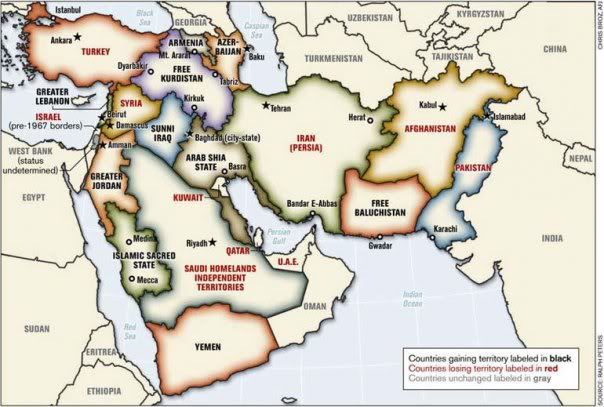
The following is the photo of the proposed map (2015) being taught at the CIA academies. More on this in a post made by Sohaib Athar.